An AI welding robot built for offshore oil and gas platforms is now working in China. It welds thick steel, plans its own passes and corrects its own path. For anyone in heavy fabrication welding, this is worth a closer look, because it targets exactly the one-off, thick-section joints that robots used to avoid.
- China's first home-built AI welding robot for offshore platforms is in service in Tianjin since June 2026.
- It welds steel up to 70 mm thick and handles parts up to 30 tons, with a reported first-pass rate above 98%.
- AI vision, 3D laser alignment and automatic multi-pass planning make it practical for one-off heavy structures.
- For QA/QC, WPS qualification, operator qualification, NDT and data traceability still apply.
What is this offshore welding robot?
In June 2026, Offshore Oil Engineering Co. (COOEC), part of China National Offshore Oil Corporation (CNOOC), put an intelligent marine welding robot system into service at its smart manufacturing base in Tianjin. It is reported as China's first domestically developed welding robot system for flexible manufacturing in marine engineering.
It is built for heavy, customised offshore structures, not for repetitive car-body work. The reported specifications are:
- Steel thickness: up to 70 mm
- Load capacity: up to 30 tons
- First-pass qualification rate: above 98% (company figure)
- Efficiency: more than 40% higher than traditional welding (company figure)
- Design life: 20 years
- Software and welding process libraries: 100% developed in-house
Before going into production, the team completed nearly 1,000 sets of welding trials and about 10 months of on-site debugging and engineering validation. The developer reports that all performance indicators met the design requirements.
How the AI welding robot works
The system combines several steps that a skilled welder normally does by eye and experience. This is what makes robotic welding possible on parts where no two joints are the same.
1. AI weld seam recognition
A vision system finds the weld joint on the actual component, so the operator does not have to teach every point by hand.
2. 3D laser vision alignment
The robot scans the real part and aligns itself to it. On heavy structures, fit-up is never perfect, so this step is critical.
3. Multi-layer, multi-pass path planning
For thick plate welding, the system plans each layer and each pass automatically, based on the joint it has just scanned.
4. Intelligent root pass and trajectory correction
It lays the root pass using real-time data and corrects the torch path during welding, instead of blindly following a fixed program.
5. Dual-sided, four-wire filling
Two sides of the joint are filled at the same time with four wires, which cuts the arc time on deep, thick-section grooves.
6. One-command start
Once the part is set up, the operator starts the complete component weld with a single command.
A companion grinding robot with visual positioning and real-time force control entered service at the same time. It has already processed more than 500 steel sections, with a reported 15% efficiency gain.
Where it fits in heavy fabrication welding
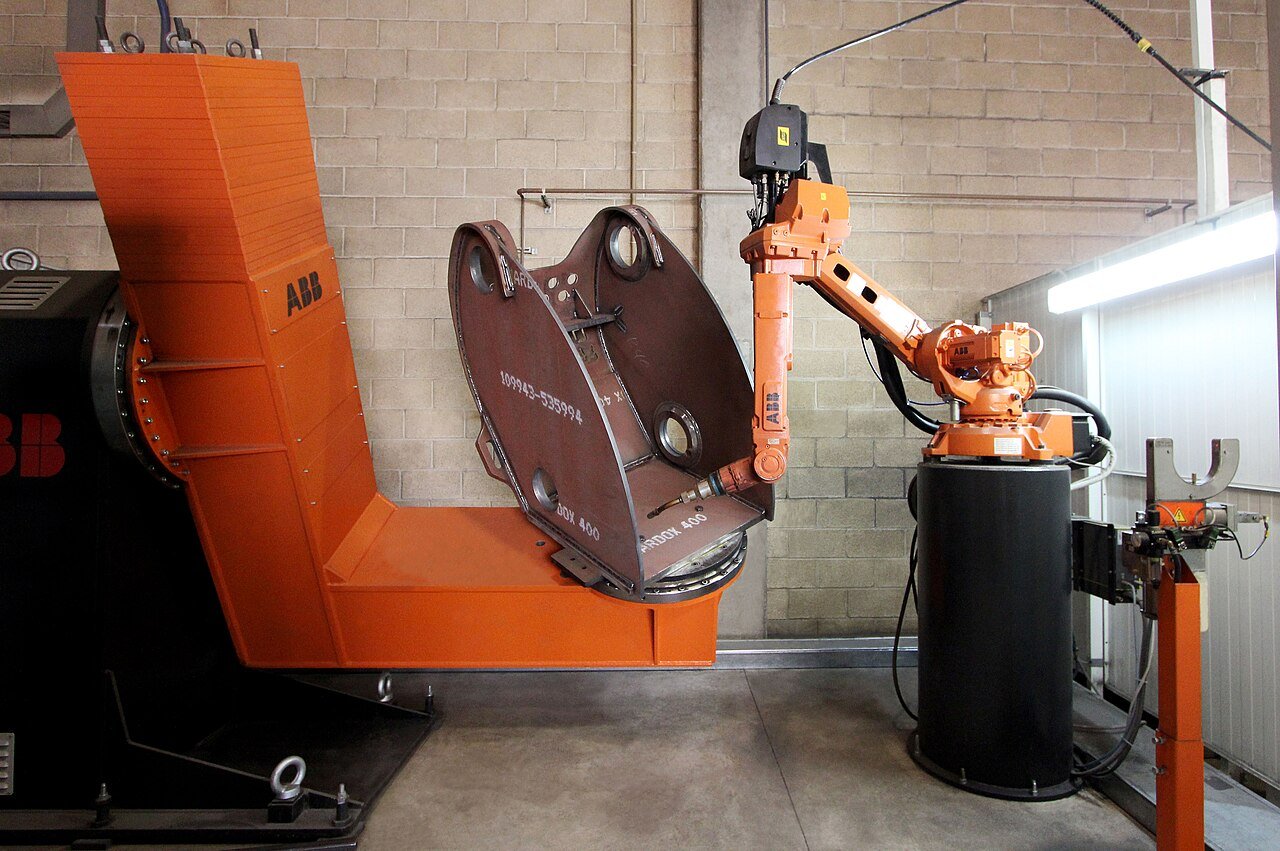
The developer lists the following offshore components:
- Offshore jacket and topside module nodes
- Deepwater jacket strengthening rings
- Buckle rings and other ring-type structural parts
From a fabrication point of view, the same approach suits any thick-section, multi-pass joint where welder fatigue, heat input control and consistency are real problems. That includes heavy structural nodes, thick ring girders and large welded assemblies.
The key point is flexibility. Older welding robots were fast only when every part was identical. Vision-guided seam finding and automatic pass planning are what make an offshore welding robot practical for one-off heavy structures.
Video: the robot at work
Video: ShanghaiEye on YouTube. If it does not load, watch it on YouTube.
What it changes for welding QA/QC
A robot does not remove the paperwork. It changes what we record, who we qualify and how much data we have for every joint. From a welding QA/QC point of view, these are the five points that matter.
Procedures still need qualification
The WPS and its supporting PQR must still be qualified for the process, material, thickness range and position that the robot welds. Automatic path planning does not replace a qualified procedure.
Welding operators join the register
The person running the system is qualified as a welding operator, not as a manual welder. Your welder register and welder continuity tracker should cover operators and the machine set-up as well.
Much more data per joint
Seam scans, path corrections and live welding parameters can be stored for every joint. This is strong evidence for traceability, but only if your weld log is structured to receive it.
NDT still decides acceptance
A 98% first-pass rate is a production figure. Every joint still needs the visual inspection and NDT that your code and client specification require. Repairs still need to be tracked and closed out.
Change control for AI corrections
When AI adjusts the torch path or parameters, the QC system must be able to show that the result stayed inside the qualified WPS ranges. This is where many shops will need new checks in their ITP.
Bottom line
Intelligent welding robots are moving from car factories into thick-section, heavy fabrication. For QC engineers, the job does not disappear. It shifts towards qualifying procedures and operators, managing machine data and proving that every joint stayed inside its qualified limits. Shops that prepare their documentation now will find it much easier to bring an AI welding robot onto the floor later.
Frequently asked questions
What is an AI welding robot?
An AI welding robot uses vision and software to find the weld seam, plan the passes and correct its path while welding, instead of only repeating a fixed, hand-taught program.
How thick can China's offshore welding robot weld?
The developer reports that the system handles steel up to 70 mm thick and parts weighing up to 30 tons.
Does a welding robot still need a qualified WPS?
Yes. The welding procedure must still be qualified with a PQR for the process, material and thickness range used, and the person running the robot must be qualified as a welding operator.
Does robotic welding remove the need for NDT?
No. A high first-pass rate reduces repairs, but each joint still needs the visual inspection and NDT required by the governing code and client specification.
Figures above are as reported by the developer and by Global Times, Xinhua and Interesting Engineering in June–July 2026. They have not been independently verified by WeldDocPro.
Sources
- Global Times: China's first self-developed marine welding robot system enters service
- Interesting Engineering: China deploys marine welding robot that handles 30-ton steel parts
- Xinhua: At your service: AI welding robots
- ShanghaiEye (YouTube): China unveils first welding robot system for offshore oil and gas platforms
- Offshore Oil Engineering Co. (COOEC) official website