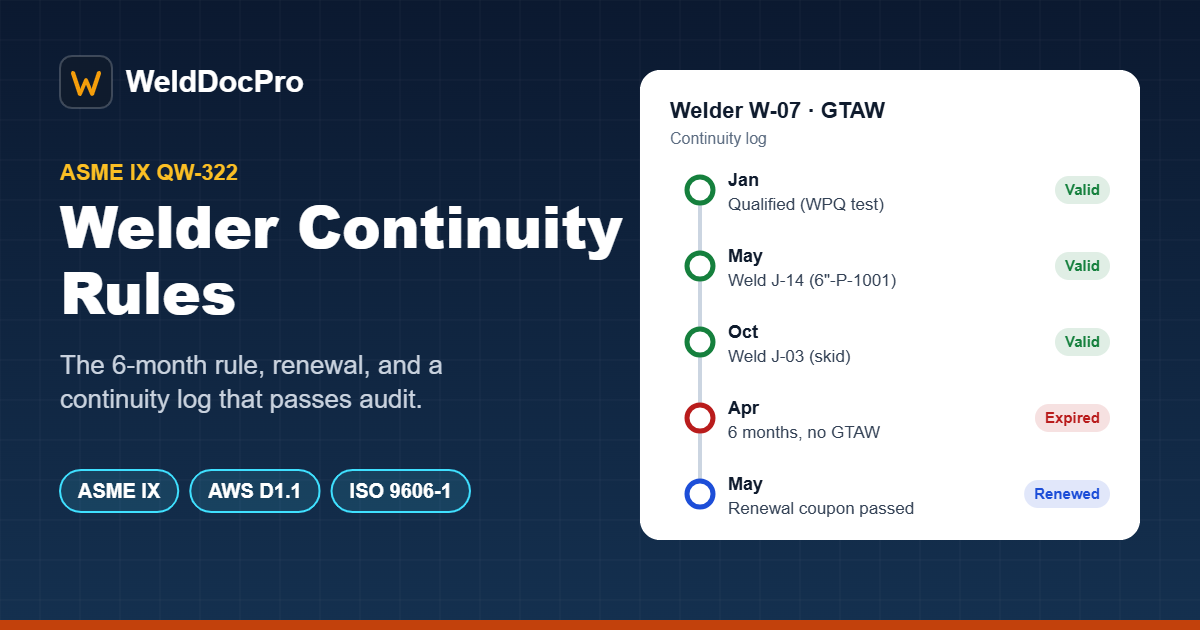
- Under ASME IX QW-322, a welder's qualification for a process expires if they don't weld with that process for six months or more.
- Any weld made with that process inside each six-month window keeps it active; the material, thickness or position don't have to match.
- It can also be revoked at any time if there is a specific reason to question the welder's ability.
- An expired qualification can be renewed with one test coupon (QW-322.2).
- You prove continuity with a welder continuity log linked to traceable welds – download a free one in Excel.
What is welder continuity?
Welder continuity is the record that shows a qualified welder has kept using a welding process often enough for their qualification to stay valid. A welder performance qualification (WPQ or WQTR – see WPS vs PQR vs WPQ) does not have a fixed expiry date under ASME Section IX. It stays valid as long as the welder keeps welding with the process, and the continuity log is the evidence.
The document goes by several names on projects: welder continuity log, welder continuity record, welder continuity report or welder continuity tracker. They all do the same job. Auditors, clients and third-party inspectors check it because a welder certificate on file proves nothing if the welder hasn't used the process for a year.
The ASME IX rule: QW-322 in plain words
The rule sits in ASME BPVC Section IX, paragraph QW-322 (expiration and renewal of qualification).
QW-322.1 – when a qualification expires
The performance qualification of a welder or welding operator is affected when either of these happens:
- Six months without the process. When the welder has not welded with a process during a period of six months or more, their qualification for that process expires.
- A specific reason to question their ability. When there is a specific reason to question the welder's ability to make welds that meet the specification, the qualifications that support those welds are revoked. Other qualifications not in question stay valid.
Two points are often misunderstood:
- Welder continuity is per process (SMAW, GTAW, GMAW, FCAW, SAW…), not per WPQ certificate, material or position.
- Welding with the process on any job, in any position and any material keeps the process alive. Your client specification can be stricter, so read it.
QW-322.2 – how to renew an expired qualification
When a qualification has expired under the six-month rule, it can be renewed for that process by welding a single test coupon – plate or pipe, of any material, thickness or diameter, in any position – and testing it as required by QW-301 (mechanical bend tests or volumetric examination where permitted). When the coupon passes, the welder's earlier qualifications for that process are renewed for the variables they covered.
A qualification revoked for a specific reason to question ability is different: the welder must requalify with a test that covers the welds in question.
Example: how the six-month window works
| Date | Event (welder W-07, GTAW) | Status |
|---|---|---|
| 10 Jan | Passes WPQ test with GTAW | Qualified |
| 2 May | Welds joint J-14 on line 6"-P-1001 with GTAW (weld log ref.) | Continuity confirmed – next due before 2 Nov |
| 20 Oct | Welds joint J-03 on a structural skid with GTAW | Continuity confirmed – next due before 20 Apr |
| 20 Oct – 20 Apr (next year) | No GTAW welding at all for six months | Expired on 20 Apr |
| 5 May | Welds one renewal test coupon, passes bend test | Renewed (QW-322.2) – next due before 5 Nov |
Many companies track a fixed six-month review cycle (for example 1 January and 1 July) instead of a rolling date. That is fine as long as no gap between two recorded welds is longer than six months.
ASME IX vs AWS D1.1 vs ISO 9606-1
| Code | Continuity rule | Renewal / revalidation |
|---|---|---|
| ASME Section IX | Expires after six months or more without welding with the process (QW-322.1) | One test coupon with the process, tested per QW-301 (QW-322.2) |
| AWS D1.1 | A similar six-month rule: the qualification stays in effect while the welder keeps welding with the process; it lapses after six months without it | Requalification test as the code requires (check the edition you work to) |
| ISO 9606-1 | The welding coordinator or responsible person confirms every six months that the welder has worked within the range of qualification | Separate certificate revalidation rules (periodic retest, revalidation based on tested production welds, or continued validity under a verified quality system), depending on the method chosen on the certificate |
For a clear summary of the ISO 9606-1 revalidation routes, see TWI's comparison of EN 287-1 with EN ISO 9606-1.
Code clauses and wording change between editions. Always check the edition named in your contract and the client specification.
Welder continuity log format: what to record
A good welder continuity log format lets an auditor check any welder in under a minute. Keep one row per welder per process:
| Column | Example |
|---|---|
| Welder ID / stamp | W-07 |
| Welder name | (as on the WPQ) |
| Process | GTAW |
| WPQ / WQTR no. and code | WPQ-GTAW-07 · ASME IX |
| Date qualified | 10 Jan |
| Last weld with this process | 20 Oct |
| Traceable reference | Weld log: 6"-P-1001 / J-14, or report no. |
| Next continuity due | 20 Apr (last weld + six months) |
| Status | Valid / Due soon / Expired / Revoked |
| Checked by / date | QC engineer, signature |
The important column is the traceable reference. A date alone is not evidence; a joint number from the weld log is. That is why continuity works best when it is fed straight from the weld log, and why every joint needs a unique number on the weld map.
Free welder continuity log (Excel template)
Download our welder continuity log Excel template and use it on your project. It follows the format above and does the date maths for you.
- 60 ready rows: welder ID, process, WPQ/WQTR no., code, date qualified, last weld and traceable reference
- Next continuity due calculated automatically (last weld + 6 months)
- Status turns Due soon 30 days before and Expired after the due date, with colours
- Drop-down lists for process (SMAW, GTAW, GMAW, FCAW, SAW…) and code (ASME IX, AWS D1.1, ISO 9606-1)
- Count of Valid / Due soon / Expired welders, print-ready landscape layout and a "How to use" sheet
- Works in Excel and Google Sheets, no macros, free to use on your projects – format no. WDP-WLD-F-002
⬇ Download the free welder continuity log (.xlsx)
How to fill the welder continuity record (example)
- Add one row for each welder and each process they are qualified for (W-07 with GTAW and SMAW = two rows).
- Enter the WPQ/WQTR number, code and date qualified from the certificate.
- Every time the welder welds with that process, update Last weld and the traceable reference (for example
6"-P-1001-A1 / J-14). - The sheet calculates Next continuity due and the Status.
- Review the log monthly, sign it and keep it with the WPQ register.
Running a bigger project? The Weld Log & Welder Continuity Tracker reads the weld log directly and updates every welder's continuity without retyping.
How to maintain welder continuity without missing one
- Link the weld log to the welder list. Every joint in the weld log records the welder stamp and process.
- Calculate "next due" automatically as the last weld date plus six months.
- Flag welders due within 30 days, so you can plan a production weld or a renewal coupon in time.
- Block expired welders from being assigned to new joints until they are renewed.
- Review the log monthly and sign it, and keep it with the WPQ register for audits.
Welder continuity review checklist
Use this welder continuity checklist when you review the log or prepare for an audit:
- ☐ Every welder on the approved list has a row for each process they use
- ☐ Every "last weld" has a traceable reference that exists in the weld log or a report
- ☐ No gap between recorded welds is longer than six months
- ☐ Welder stamps match the welder register and the WPQ certificates
- ☐ Expired welders are removed from the approved list or have a renewal test on record
- ☐ The log is signed and dated by the responsible QC person
- ☐ The client specification has no stricter rule you have missed
Common audit findings on welder continuity
- Continuity "confirmed" with a signature but no traceable weld behind it.
- Continuity kept for one process only while the welder is listed for two (for example GTAW root + SMAW fill).
- Welders on the approved list whose qualification expired months ago.
- Welder stamps in the weld log that don't match the welder register.
- Continuity log not updated after a long shutdown or project gap.
Frequently asked questions
What is the welder 6-month rule?
Under ASME Section IX QW-322, a welder's performance qualification for a welding process expires if the welder has not welded with that process for a period of six months or more. Welding with the process within each six-month period keeps the qualification active.
Does the welder have to weld the same material or position to keep continuity?
Under ASME IX, continuity is tied to the welding process. Welding with the process maintains the qualification; it does not need to be the same material, thickness or position. Always check your client specification, which can be stricter.
Does welding with one process keep another process qualified?
No. Continuity is tracked per process. A welder qualified for GTAW and SMAW must weld with each process within each six-month period to keep both qualifications.
How is an expired welder qualification renewed under ASME IX?
QW-322.2 allows renewal by welding a single test coupon with that process, of any material, thickness or diameter and in any position, and testing it as required by QW-301. Passing renews the qualification for the variables previously qualified.
What records prove welder continuity?
A welder continuity log or record that lists, for each welder and process, the date and traceable reference of a weld made with that process at least every six months, such as a weld log entry, joint number or report number.
Is there a free welder continuity log template?
Yes. Download the free welder continuity log in Excel. It calculates next-due dates and shows Valid, Due soon and Expired for every welder and process.
Is the ISO 9606-1 six-month confirmation the same as ASME continuity?
They are similar but not the same. ISO 9606-1 requires the welding coordinator or responsible person to confirm every six months that the welder has worked within the range of qualification, and sets separate rules for revalidating the certificate.
References and further reading
- ASME BPVC Section IX – Welding, Brazing and Fusing Qualifications (ASME)
- AWS D1.1/D1.1M:2025 Structural Welding Code – Steel (American Welding Society)
- AWS standards and publications (American Welding Society)
- ISO 9606-1 – Qualification testing of welders, fusion welding, steels (ISO)
- A comparison of BS EN 287-1 with BS EN ISO 9606-1 (TWI)
Related WeldDocPro guides: WPS vs PQR vs WPQ · How to prepare a WPS · Free WPS format in Excel · Free weld map maker
This guide explains the rules in plain words for day-to-day QC work. It does not replace the code: always work to the current edition named in your contract and your client specification.
← All guides · Previous: Free weld map maker